
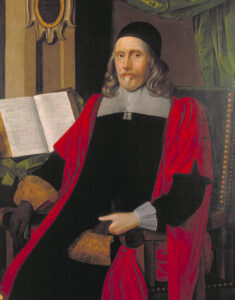
Chief Justice Edward Coke
In 1607, King James I of England decided a land dispute in what came to be called the Case of Prohibitions. When the case came before Edward Coke, the Chief Justice of the Court of Common Pleas, he overturned the decision of the King, holding that such matters could only be tried subject to the rule of law. As Coke described his decision in his Institutes, he had held “that the law was the golden met-wand and measure to try the causes of the subjects; and which protected His Majesty in safety and peace : with which the King was greatly offended, and said, that then he should be under the law, which was treason to affirm, as he said; to which I saith … quod Rex non debet esse sub homine, sed sub Deo et lege [that the King ought not to be under any man but under God and the law.]”
Harvard College was founded just 29 years after Chief Justice Coke confronted his king with those words, and eventually NON SUB HOMINE SED SUB DEO ET LEGE would be inscribed in a commanding frieze above the main entrance of Harvard Law School. Chief Justice John Roberts would have passed under that motto hundreds of times during his training at the school. So would Justices Kagan, Gorsuch and Jackson while they were students there, while Justice Kagan, who would later become Dean of the Law School, would have had even more opportunity to ponder the school’s masthead.
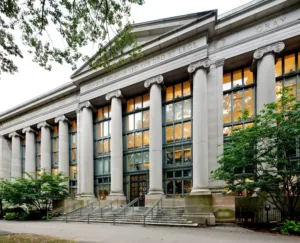
Harvard may well find itself invoking some version of Coke’s words in its own bitter struggle with the Trump administration. But even sooner and perhaps of greater consequence, John Roberts and his colleagues may have to decide whether or not to remind the president that, powerful as Roberts has ruled that the president rightfully is, he is still subject to the law. The case where that reminder seems most likely to become necessary is Abrego Garcia v. Noem, the wrongful deportation case on which the Court has already ruled once and where it may well have to decide whether to sustain a contempt finding against the administration.
Both in its April 10 ruling in Abrego Garcia v. Noem and (more notoriously) in its 2024 decision in the presidential immunity case of Trump v. United States, the Roberts court has made clear its fundamental deference toward the executive branch when it is acting within its constitutionally prescribed arena. Chief Justice Coke, too, showed deference to the executive, as well he might in an age still rife with beheadings for smaller slights than his. Yes, the king was as nearly omnipotent as any human might well be, Coke acknowledged … but he was still subject to higher powers, not least the rule of law.
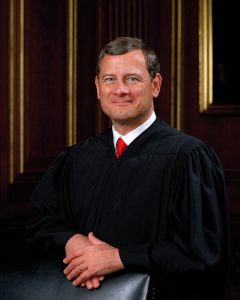
Official portrait of U.S. Supreme Court Chief Justice John G. Roberts.
The border between exercising legitimate presidential prerogative and transgressing the rule of law is a fine line, which Roberts is clearly intent on drawing carefully. Among other things, he and his colleagues have appropriately let the trial court develop the record upon which any eventual finding of contempt of court could stand or fall. From the outside, contempt in its ordinary, everyday sense seems like an accurate description of the administration’s stonewalling of the judiciary’s directives to “facilitate” Abrego Garcia’s return. Surely a president who intends to buy Greenland could find a way to secure the release of one wrongly deported prisoner.
Instead, as the Fourth Circuit Court of Appeals wrote in this same case, “The government is asserting a right to stash away residents of this country in foreign prisons without the semblance of due process that is the foundation of our constitutional order. Further, it claims in essence that because it has rid itself of custody that there is nothing that can be done. This should be shocking not only to judges, but to the intuitive sense of liberty that Americans far removed from courthouses still hold dear.”
It may be that “intuitive sense of liberty” on the part of ordinary citizens that will have to resolve a constitutional crisis arising in this or some other case in which the Trump administration tests the limits of presidential power and prerogative. Always lurking in the background of this potential crisis is Andrew Jackson’s supposed response to Chief Justice John Marshall’s ruling in Worcester v. Georgia: “The Chief Justice has made his decision, now let him enforce it.” Whether Jackson ever actually said that or not, the fact remains that, in any constitutional standoff between the executive and judicial branches, the judiciary holds by far the weaker hand in terms of access to means of coercion. What it has on its side is whatever depth and breadth of respect for the rule of law may exist among the citizenry of the country.
I believe that we here in Montana have had a glimpse of this dynamic during our just now ending legislative session. As I outlined in a recent blog post, both Montana’s Republican governor and the Republican leadership in the legislature had made a concerted and sustained effort to place partisan labels on the state’s judicial races, obviously in the belief that this now bright red state would favor judges with an “R” behind their names on the ballot.
Our newly elected Chief Justice, Cory Swanson (who had been a Republican throughout his career before running for the high court) used the occasion of his State of the Judiciary address to the legislature to oppose these efforts by his own native party. “I urge you to reject legislation that will undermine the effective functioning of the judiciary, not because judges don’t like it, but because it will ultimately harm Montana citizens,” the Chief Justice declared. In fact, enough Republican legislators joined a solid Democratic phalanx to defeat the numerous and repeated efforts to make our judicial elections partisan.
By himself, Chief Justice Swanson would not likely have been able to achieve that result. But with the dogged efforts of a new organization called Friends of the Third Branch, backed up by strongly bipartisan citizen opposition to making judicial elections partisan, Montana gave a resounding endorsement to the nonpartisan rule of law that the chief justice had invoked.
Meanwhile, at the national level, the breadth and depth of that reservoir of respect for the rule of law is being put to the test every day. No chief justice and no court, standing alone, can withstand an assault by a determined executive branch against the rule of law. What gives any chief justice — or any judicial branch — its authority in the face of such defiance, is an equally determined civil society, comprised of stalwart citizens and institutions like Friends of the Third Branch or the hundreds of university presidents who chose this week to “speak with one voice against the unprecedented government overreach and political interference now endangering American higher education.” In that company, we all have a role to play in defense of the rule of law.
________________________
Daniel Kemmis is the author of Citizens Uniting to Restore Our Democracy


Leave A Comment