

In 1984, while serving as the Democratic Speaker of the Montana House of Representatives, I filed for the soon-to-be-vacant position of Chief Justice of the Montana Supreme Court. When the filing deadline arrived, only one other candidate had come forward: the former Republican Senate President, Jean Turnage. While my opponent and I were leaders in our respective parties, there was no (R) after his name on the ballot, nor a (D) after mine.
That turned out to be the only electoral race I ever lost, but I lost it for some very good reasons, none of which had to do with my party affiliation or that of my opponent. In 1984, at 39, I was a mere six years out of law school, while Jean Turnage, at 58, had been practicing law for 33 years. His legislative career, too, had spanned more than twice as many years as my own, and if the truth be told, it showed: in a steady, sometimes crafty and nearly always successful legislative mastery that I could often admire but rarely match. Tall and gangly beside Turnage’s shorter, more compact frame, I sometimes told my friends that I thought his chief advantage was his lower center of gravity, by which I meant more than his physique.
While I would often disagree with Turnage’s judicial decisions during his sixteen years as Chief Justice, I could never seriously doubt that Montanans knew what they were doing in choosing his age and experience and frankly, wisdom, over mine. And although last year, Montanans again chose a Republican over a Democrat for Chief Justice, I had again to acknowledge their trans-partisan common sense when the new chief told the Republican legislature that he opposed their efforts to allow (if not require) party designations in Montana judicial races.
Near the end of his “state of the judiciary” address to a joint session of the legislature, the new Chief Justice, Cory Swanson, announced that it was “time to talk about the elephant and the donkey in the room.” Swanson then proceeded to put Republican judicial reform efforts in the context of a recent stream of Montana court rulings against (Republican) legislative enactments. “Some say the Court has repeatedly over-ridden Legislative policy-making authority and skewed its own canons of interpretation to reach pre-determined case outcomes,” Swanson recounted. “Others say the Legislature has passed blatantly unconstitutional laws, and then blamed the Court for striking them down.”
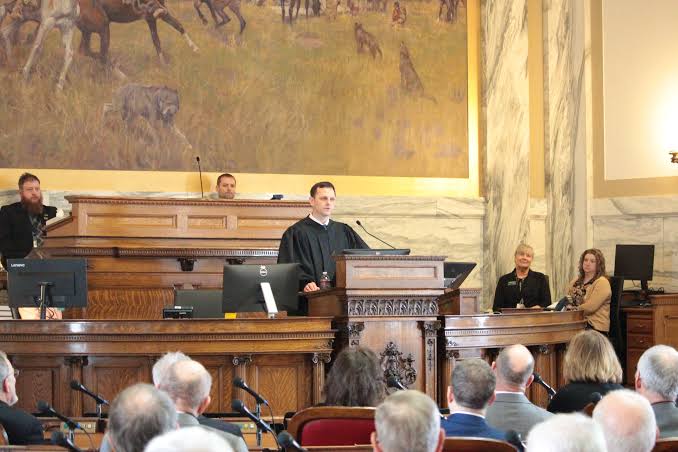
Chief Justice Cory Swanson addressing Montana Legislature
The Chief Justice went on to declare that “these pitched battles have led some to say the non-partisan nature of the judiciary is a façade, and we should openly declare political affiliations of candidates and Supreme Court Justices. … But I urge you to reject legislation that will undermine the effective functioning of the judiciary, not because judges don’t like it, but because it will ultimately harm Montana citizens.”
The opposing argument also emphasizes the interests of the state’s citizens. In a recent op-ed piece appearing in most Montana dailies, the chair of the Montana Republican Party wrote, “Montanans expect fairness, accountability, and transparency from their elected officials, yet voters are often left in the dark about judicial candidates. Current legislation would allow judicial candidates to run with party affiliations, giving voters a clearer picture of their judicial philosophy.”
This is a plausible argument, deserving more than a knee-jerk dismissal. In Citizens Uniting to Restore Our Democracy, I wrote about how the informative value of party labels had contributed to their role in American history. “To the extent that the emergence of organized political parties enabled Americans to choose intelligently and meaningfully among contrasting sets of policies, parties were (and are) an important element of the machinery of democracy,” I wrote. Indeed, it was this valuably informative feature of party labels that led me to oppose an effort to make Missoula’s municipal elections nonpartisan in 1996.
Like so much of public life, though, this is a matter where context is highly significant. Policymakers like mayors, legislators or governors are legitimately chosen on the basis of their support for certain clusters of policy. But policymaking is not part of a judge’s job description, nor should it be. Nothing is more central to the separation of powers than our expectation that judges will interpret the laws that legislators make and executives propose and enforce. That fundamental principle is certainly a major reason why the vast majority of states select their judges on a nonpartisan basis, with only seven of the fifty opting for partisan judicial elections.
At a time when our public life is threatened above all by too much money and too much partisanship, it is a singularly bad idea to increase the influence of either. For the time being, there is little we can do to staunch the flow of money. But at least at the state level, we can say no to the effort to make partisanship more prevalent in the judicial branch.
At the national level, the challenge is different, but no less crucial. Party politics have hovered over the national judiciary at least since the time of John Adams’ appointment of several “midnight judges,” including Chief Justice John Marshall, in the last weeks of his presidency.
Party politics sank to a new low in this arena in 2016, when Senate majority leader Mitch McConnell refused for 8 months to hold hearings on President Obama’s nomination of Merrick Garland to replace Antonin Scalia on the Supreme Court. McConnell claimed that the nomination came too close to the presidential election, yet when Justice Ruth Bader Ginsburg died less than two months before the 2020 election, McConnell rushed President Trump’s nomination of Amy Coney Barrett through the Senate with blinding speed.

Justice Barrett
The net result of McConnell’s artful hypocrisy has been a 6-3 conservative-liberal split on the Supreme Court, reflecting the party labels of the presidents who made each appointment. Yet I believe that Justice Barrett was sincere when she told an audience in 2021 that “[m]y goal today is to convince you that this court is not comprised of a bunch of partisan hacks.” Barrett gave her words substance earlier this month when she and Chief Justice John Roberts joined the Court’s three liberal justices in thwarting Trump’s efforts to freeze $2 billion in foreign aid. Nor was this by any means the first time that Barrett, Roberts, or sometimes Justices Kavanaugh or even Gorsuch, have jumped “party lines” in particular cases.
In my next post, I will explore the possibility of this kind of trans-partisanship becoming more of a norm and less of an exception with today’s judiciary.
Daniel Kemmis is the author of Citizens Uniting to Restore our Democracy


Leave A Comment