
Near the end of my last post, I speculated that Supreme Court Justices Thomas and Alito may retire while the Republicans control both the presidency and the Senate. If so, they would almost certainly be replaced by considerably younger (and assuredly conservative) jurists. The result could well be several decades of lopsided conservative dominance of the Supreme Court. For American conservatives, this would be a welcome turn of events, while for liberals, already reeling from the barrage of second term Trump activities, it is a deeply depressing prospect.
As a congenital optimist, I am driven to find a silver lining in even the darkest of clouds, and so I will with this situation. Pollyanna herself would be hard-pressed to find any bright rays of hope here, but faint glimmers of real light are going to be more helpful than shining mirages. What might such realistic optimism look like here?
One mildly promising factor is the concern for legacy – for how this Court will be viewed decades and even centuries from now. This is quite clearly a consideration for Chief Justice Roberts, since this will inevitably be known as the “Roberts Court.” Concern for that legacy has already shown up in several of Roberts’ decisions, not least his 2012 opinion where he was joined by what were then four liberal justices in upholding the Affordable Care Act.
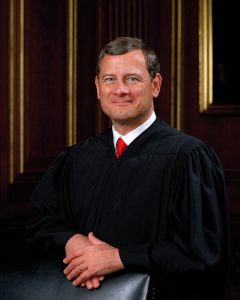
Official portrait of U.S. Supreme Court Chief Justice John G. Roberts.
Justice Gorsuch has also displayed a concern for the Court’s long-term legacy, particularly in his 2019 book A Republic, If You Can Keep It. As a former teacher of constitutional law, Justice Barrett brings to the Court a trained appreciation for how well or how poorly current decisions withstand the test of time. She captured key features of a decision’s durability in a talk at the Ronald Reagan Library in April 2022: “Does this read like something that was purely results driven and designed to impose the policy preferences of the majority or does this read like it actually is an honest effort, a persuasive effort … to determine what the Constitution and precedent requires as applied to a particular problem at hand?”
I wouldn’t expect to see a concern for the Court’s legacy revealing itself in the reversal of many of the current Trump-Musk initiatives. The conservative majority made it clear in its presidential immunity decision last year that it reads Article II of the Constitution as endowing the presidency with expansive executive powers. As Chief Justice Roberts put it, “once it is determined that the President acted within the scope of his exclusive authority, his discretion in exercising such authority cannot be subject to further judicial examination.”
On the other hand, Roberts wrote, “If the President claims authority to act but in fact exercises mere “individual will” and ‘authority without law,’ the courts may say so.” Given Trump’s penchant for pushing limits, it would be surprising if the Court did not at some point find that he had exceeded this one. But in general, I would expect substantial deference by the Court to executive prerogative.
A more vexing question for the Court’s conservatives may lie in the degree of deference they show to the remaining branch: the legislative. This brings into focus the issue of judicial restraint, which in its most basic form maintains that the courts interpret laws but leave legislating to the legislative branches of national and state governments. In these terms, judicial restraint is a fundamental principle of conservative jurisprudence. Thus the conservative Federalist Society asserts (in John Marshall’s words) “that the separation of governmental powers is central to our Constitution, and that it is emphatically the province and duty of the judiciary to say what the law is, not what it should be.”
That, in fact, was the core of the Roberts Court’s reasoning in Dobbs v. Jackson. In recanting what the opinion called “Roe’s abuse of judicial authority,” the Court’s conservative majority decried Roe’s departure from judicial restraint and “return[ed] the issue of abortion to the people’s elected representatives.”
The question now is whether, in an appropriate case, some of those same conservatives might muster the intellectual integrity to do the same with two other egregious “abuse[s] of judicial authority” and “return … to the people’s elected representatives” their rightful control over two crucial issues: gun safety and campaign finance.
Make no mistake: in these two arenas, the core of the law under which we now live (and suffer immeasurable harm) is not law made by legislatures, but by the Supreme Court. The Court made those laws in two acts of radical judicial activism, namely its decisions in District of Columbia v. Heller (2007) and Citizens United v. FEC (2010). A truly conservative Court, adhering to the principle of judicial restraint, would never have allowed itself to legislate in that way.
In his majority opinion in Heller, Antonin Scalia created out of whole cloth the private citizen’s constitutional right to gun ownership by cynically depriving of all meaning – essentially erasing — the Second Amendment’s first 13 words: “A well regulated militia being necessary to the security of a free state …” If we imagine a case where the Court is asked to overrule Heller as it overruled Roe, Justice Barrett would have an opportunity to ask whether Scalia’s intellectual gymnastics “read like something that was purely results driven and designed to impose the policy preferences of the majority or does this read like it actually is an honest effort, a persuasive effort, … to determine what the Constitution and precedent requires as applied to a particular problem at hand?”

Of even greater significance than Heller was the majority opinion in Citizens United. I devoted most of two chapters of Citizens Uniting to Restore Our Democracy to analyzing the flawed reasoning behind our Court-imposed campaign finance law, so I will not attempt to summarize it here. If you need reminding of the disastrous consequences of Citizens United’s abandonment of judicial restraint, watch Elon Musk threaten to spend millions to unseat Republicans hesitant to impeach judges who cross Musk and Trump. Conservative Justice John Paul Stevens’ closely-reasoned dissents will provide the basis for overturning both Heller and Citizens United whenever enough of the justices who overturned Roe v. Wade and affirmative action are ready to bring even a modicum of intellectual honesty to that task.
Daniel Kemmis is the author of Citizens Uniting to Restore Our Democracy


Leave A Comment