
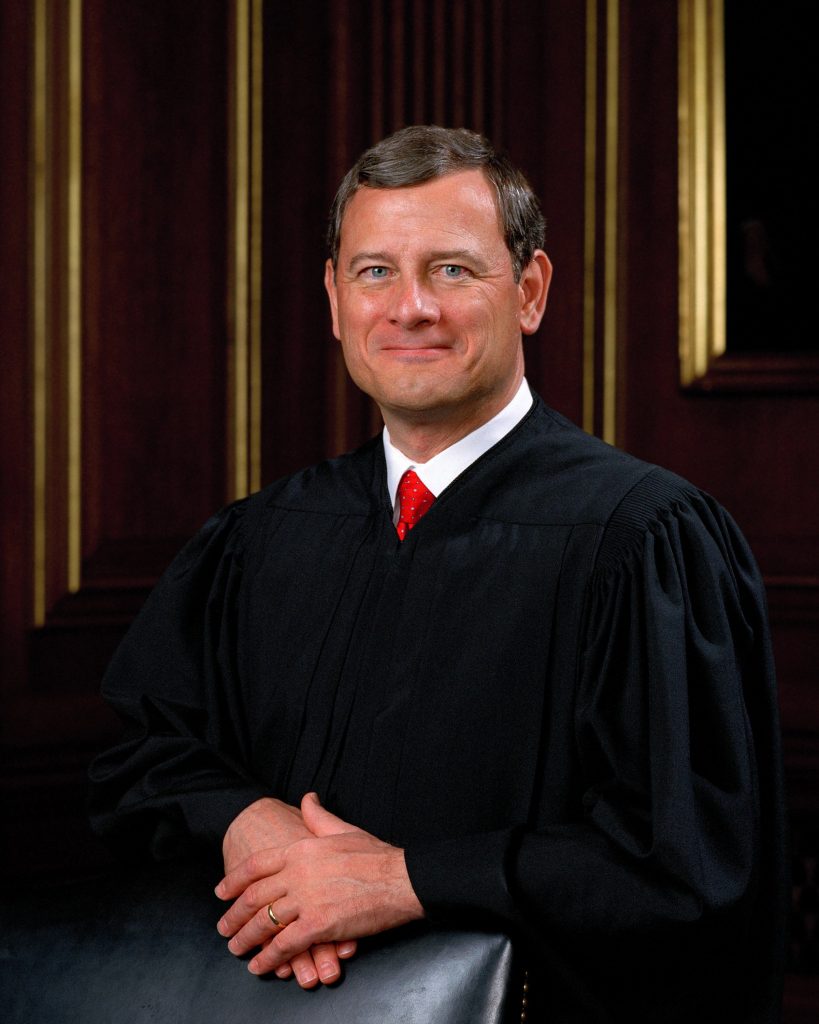
Official portrait of U.S. Supreme Court Chief Justice John G. Roberts.
The struggle between the Trump administration and the federal judiciary over District Judge James Boasberg’s order temporarily blocking the administration’s plan to deport Venezuelan immigrants escalated this week after administration officials ignored the order and Trump, calling the judge a “Radical Left Lunatic, a troublemaker and agitator,” called for his impeachment. When Republican House members duly set impeachment wheels in motion, Chief Justice John Roberts rebuked Trump (without naming him) by noting publicly that “Impeachment is not an appropriate response to disagreement concerning a judicial decision.”
The incident stirred speculation about a constitutional crisis, reviving historical memories of an 1832 Supreme Court decision in favor of the Cherokee Indians and against the policy of President Andrew Jackson, who is said to have responded that “John Marshall has made his decision, now let him enforce it.” Whether Jackson ever actually said this is somewhat doubtful, but the constitutional implications are as clear now as they would have been then: the courts themselves possess no police, military or other coercive power to enforce their decrees.
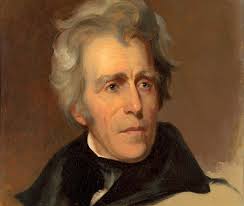
Andrew Jackson
Given all the unprecedented and attention-grabbing actions the second Trump administration has taken in its first two months, it is not at all inconceivable that Trump would decide to defy a ruling of the Supreme Court that undermined or countermanded a policy or program popular with his base. What would happen then?
To put it another way, what gives something as flimsy as a mere law any effective force against a willful executive?
In a democracy, there are two essential and intertwined answers. The people must believe so firmly in the legitimacy of the law that they will not stand for its being ignored or broken. And judges must bring enough integrity to their interpretation of the laws that the people grant them that legitimacy. If either of these elements are absent or seriously weakened, the law will fail to constrain a willful executive.
Both the people and their courts must play their roles seriously and intelligently if we are to preserve the rule of law through any serious constitutional crisis. To do that, the judiciary, and especially the Supreme Court, will need to step up their game in terms of maintaining and nurturing their judicial temperament. At the same time, both courts and citizens are going to need to cultivate a brand of judicious behavior that has become all too rare in our deeply polarized society.
This second need was illustrated by a New York Times headline this week: Judges Fear for Their Safety Amid a Wave of Threats. “The attempts at intimidation have taken many forms,” the Times reported: “bomb threats, anonymous calls to dispatch police SWAT teams to home addresses, even the delivery of pizzas, a seemingly innocuous prank but one that carries a message.” (The message is, “We know where you live.”) This latest wave of incivility may come primarily from Trump’s base, but liberals picketing conservative justices’ homes fall in the same category. A determined, bipartisan stand against this kind of behavior would be a good first step toward a more judicious citizenry.
Another, probably more challenging step, is for more of us to suppress our inclination to assume that every judicial decision we disagree with is the result of partisan or otherwise evil motivation. In these terms, I commend Justice Barrett’s observation in a talk at the Ronald Reagan Library in April 2022. Asked about public criticism of the court’s opinions, Barrett urged people to read the opinion before making a judgment on whether it was wrong. They should ask themselves: “Does this read like something that was purely results driven and designed to impose the policy preferences of the majority or does this read like it actually is an honest effort, a persuasive effort, even if one you ultimately don’t agree with, to determine what the Constitution and precedent requires as applied to a particular problem at hand?”
Here, Barrett was asking us as citizens to be more judicious in our interpretation of judicial actions. At the same time, she was providing a thumbnail sketch of the kind of judicial temperament that would produce decisions worthy of such scrutiny.

Justice Amy Coney Barrett
For my money, the key word in Barrett’s question is “honest.” If there is one trait that can make a difference in how the Roberts Court is regarded down the coming centuries, it will be the intellectual honesty either present or absent in its major decisions. In those terms, I have considerable faith in Barrett herself to provide constructive leadership. She is the least likely of her conservative colleagues to accept intellectually lazy or worse, intellectually dishonest maneuvers. One result is that she is the most likely to find herself in agreement with the other three women on the Court, and often with Roberts or another of her conservative colleagues.
We saw an example of Barrett’s own judicial temperament in the 2024 decision to allow Trump’s name on the ballot in Colorado. “In my judgment, this is not the time to amplify disagreement with stridency,” Barrett wrote. “The Court has settled a politically charged issue in the volatile season of a Presidential election. Particularly in this circumstance, writings on the Court should turn the national temperature down, not up. For present purposes, our differences are far less important than our unanimity: All nine Justices agree on the outcome of this case. That is the message Americans should take home.”
This effort to urge both her liberal and conservative colleagues — and also the media — to lower rhetorical temperatures and replace ideological with pragmatic analysis has all the hallmarks of a long-term, legacy-building approach. It’s not hard to imagine the Court’s two former law school professors, Justices Barrett and Kagan, taking the lead in such an endeavor. This is not to deny that the Court’s liberals should dissent, and dissent vigorously, when that is called for. But when genuine intellectual honesty can lead to the crossing of ideological boundaries, the court and the country will be the better for it.
It seems inevitable that the Supreme Court and indeed the entire national judiciary will bear a conservative stamp for many years, if not decades, to come. Justice Thomas is all but certain (and Alito likely) to retire in time for Trump and the Republican Senate to replace them with much younger conservatives. Meanwhile, those same dynamics will push the lower tiers of the national judiciary in the same direction. Under those circumstances, it becomes increasingly crucial to ask whether that judiciary will be blatantly partisan, or simply conservative, and if the latter, what kind of conservative? I will take up that last question in my next blog post.
Daniel Kemmis is the author of Citizens Uniting to Restore Our Democracy


Leave A Comment