
I’m going to start with some ancient history to introduce a couple of the players in this story.
In 1981, during my tenure as the minority leader of the Montana House of Representatives, I met a young intern who was working for another member of the Missoula delegation. That intern, Mike Kadas, ran for a vacant seat himself the next year, becoming part of a new Democratic majority that enabled me to become Speaker of the House.
Fast forward a decade, when I was running for reelection as mayor of Missoula, facing a tough race primarily because a fairly aggressive annexation policy during my first term had created a large crop of new Missoula voters eager to express their displeasure at having been given the opportunity to help pay for services they had become accustomed to using for free. Knowing I needed to take this race seriously, I followed the advice of some savvy friends and hired a bright young poli sci student from the university to run my campaign.
Jim Messina did a good job with that campaign, as he did with many others in the coming years, including Barack Obama’s reelection campaign in 2012, which Messina managed brilliantly. Meanwhile, when I moved from the mayor’s office to lead the Center for the Rocky Mountain West in 1996, I had encouraged Mike Kadas to apply for the position of mayor. He ended up serving there through 2005, when both Kadas and I backed John Engen’s candidacy for the first of what would become his five elections as mayor.
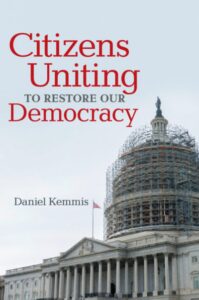
When, in January 2010, the United States Supreme Court rewrote American campaign finance law with its 5-4 decision in Citizens United v. FEC, I began writing the book that would become Citizens Uniting to Restore Our Democracy. From the outset, my central thesis was that our best chance of healing the wounds inflicted by SCOTUS and by ever-more intractable partisanship was to call on the reserve of solid, sensible local citizenship that I had come to prize so highly during my tenure as mayor.
Mayor John Engen died in 2022, setting the stage for this year’s mayoral election. I endorsed Mike Nugent, a city council member, a realtor, and the son of the city attorney who had served Kadas, Engen and me. Six months after I had made the maximum allowable contribution to the campaign ($400) I was flabbergasted to learn that the National Association of Realtors had made a $125,000 contribution to a superPAC created to support Nugent.
I immediately contacted Mike Nugent to tell him that I could not allow my name to be associated with a campaign benefiting from such an overwhelming infusion of outside, special-interest money. Mike Kadas and I (now the only living ex-mayors) wrote an opinion piece expressing our dismay at this unprecedented intrusion into our local election.
We can now return to Jim Messina, who responded to the Kadas-Kemmis op-ed by asking, “Shouldn’t elections be about the best candidate? It’s the height of arrogance to encourage people to not support Mike Nugent, who clearly is the best candidate, because a group he has no control of and can’t coordinate with, wants to help him. The problem is the Supreme Court, not a candidate. And I will continue to support the best candidate because the future of Missoula is at stake.”
While I don’t relish being accused of arrogance, and while I don’t believe that either Mayor Kadas or I merit that charge in this case, the rest of Jim Messina’s argument carries a patina of plausibility that deserves a more thoughtful response.
What Jim says here could presumably be said of any superPAC, a fact which brought to mind a passage in Citizens Uniting where I quoted Messina on this very subject. Here is the passage from the chapter of Citizens Uniting entitled “Partisan Quicksand”:
“Early in February [of 2012], President Obama’s re-election organization announced that he was reversing his earlier position and would now encourage his supporters to contribute to a “super PAC” of the kind that Citizens United and its judicial offspring had unleashed on the political landscape two years earlier. … Obama’s campaign manager, Jim Messina, outlined those realities in an email to campaign supporters. Declaring that “we will not play by two sets of rules,” Messina explained:
“The President opposed the Citizens United decision. He understood that with the dramatic growth in opportunities to raise and spend unlimited special-interest money, we would see new strategies to hide it from public view. … And the President favors action – by constitutional amendment if necessary – to place reasonable limits on such spending. But this cycle, our campaign has to face the reality of the law as it currently stands.”
I went on in Citizens Uniting to state that, “The point here is not to quarrel with the decision of Obama or his advisors but rather to illustrate how, in the arena of campaign finance, even the best-intentioned of politicians are trapped in something very like quicksand.” I concluded that chapter by arguing that, if even well-intentioned politicians felt compelled to do things like establishing superPACs that they had previously condemned, thus contributing to the ever-worsening quagmire of too much money and too much partisanship in our politics, then it might be up to citizens, standing on firmer democratic ground, to rescue our sinking institutions by “putting steadily more weight on that solid democratic footing.”
In that spirit, the next chapter, entitled “The Solid Ground of Everyday Citizenship,” examined how local democracy had maintained sinews of democratic strength that were rapidly failing at larger scales. As Mayor Kadas and I pointed out in our op-ed piece, the reason we were so alarmed by the totally unprecedented scale of the realtors’ superPAC contribution was because it threatens to spread the deadly quicksand to the local level, and thus to undermine one of the only grounds of democratic strength from which we have any hope of rescuing our larger political institutions.
The quicksand will assuredly spread here, and to other communities across the country, unless citizens unite in proclaiming in unmistakable terms that “our local governments are not for sale.” Candidates for mayor, above all, should be vigilant in making sure that such outside influence is not being injected into their community’s election. Failing that, and hard as it may be on unwary (or perhaps naïve) candidates like Mike Nugent, the only feasible way to protect the integrity of local elections is not to elect any candidate in whose name outside interests might ever attempt to buy our elections.


Leave A Comment