
Last week, while the U.S. House Select Committee to Investigate the January 6th Attack on the United States Capitol continued its hearings into the most serious assault on American democracy in living memory, Montana was celebrating the 50th anniversary of its current constitution. That document was repeatedly praised for its many exemplary democratic rights and principles. To cite but one example, as the U.S. Supreme Court seemed poised to withdraw constitutional protection from women seeking an abortion, on the grounds that the U.S. Constitution does not contain a right of privacy, the Montana constitution, adopted less than a year before Roe v. Wade did, quite explicitly, guarantee that very right of privacy. That pioneering provision is now expected to protect women’s reproductive choices in this state regardless of what the U.S. Supreme Court might decide.
Significant as such state constitutional provisions can be, Montana’s celebration of its constitution reached even deeper, inviting participants to think about the bedrock foundations of republican self-government. Those roots were most eloquently expressed in the preamble to Montana’s constitution:
We the people of Montana grateful to God for the quiet beauty of our state, the grandeur of our mountains, the vastness of our rolling plains, and desiring to improve the quality of life, equality of opportunity and to secure the blessings of liberty for this and future generations do ordain and establish this constitution.
The preamble’s encomium to Montana’s landscapes may seem superfluous in a document whose purpose is to establish a governing system for the state. But I would argue that this language, totally absent from the preambles of both the U.S. and the original 1889 Montana constitutions, may prove to be one key to healing the severe illness now afflicting our politics at both the state and national levels.
That fundamental unhealthiness may be found buried underneath the first word of all these preambles: “we.” Just about as short and simple as a word can get, that opening pronoun is easily taken for granted. But I want to suggest that in some ways, it’s the most difficult, the most challenging word, not only in the Montana and U.S. preambles, but in the following documents themselves. The challenge that word poses might serve as a touchstone for what it will take to heal our politics.
It may not be too much to say that no people can be truly self-governing unless they can pronounce the word “we” with genuine understanding and conviction. And never since the Civil War has it been more challenging than it is now to speak that word in that way.
To my mind, the greatest blessing of the Montana preamble is the unforgettable way in which it unfolds for us, every time we read it, the meaning that Montanans intended to express with that “we.” “We, the people of Montana, grateful to God for the quiet beauty of our state, the grandeur of our mountains, the vastness of our rolling plains …” We, in other words, are people of this place, and we are grateful for that. We gratefully call Montana “the last best place,” a bit of smugness that could only begin to be justified if we were committed, not just individually but all of us together, to making and keeping Montana in some way worthy of that title.
The key word here is “keeping.” What struck me most forcefully about the 50th anniversary event was not the backward glance to the early ’70’s, although there was, quite appropriately, plenty of that. But the preamble’s invocation of “this and future generations” was taken quite seriously and with a good deal of intentionality, from both sides of the political aisle. Here we had, for example, both Dorothy Bradley and Marc Racicot, who had run against each other for governor in 1992, now each in their own way pointing beyond the bitter partisanship of our day, pointing back to more civil times but even more important, pointing forward into a shared Montana future of which we all might be proud.
Marc Racicot had prevailed in that 1992 race, serving for two terms as Montana’s governor. A few months before the 50th anniversary event, Racicot, who had served as chair of the Republican National Committee early in the century, had written in an op-ed piece for the Washington Post entitled “Trump is Wasting Our Time“:
“Rarely stopping to inventory the essential qualities in human character, we all know them when we see them: decency, honesty, humility, honor and faithfulness. My purpose is to urge all Americans of good sense and honest purpose to confront, define and vindicate the truth. Sometimes that truth has sharp edges, but nonetheless, it is still the truth. This is one of those times.“
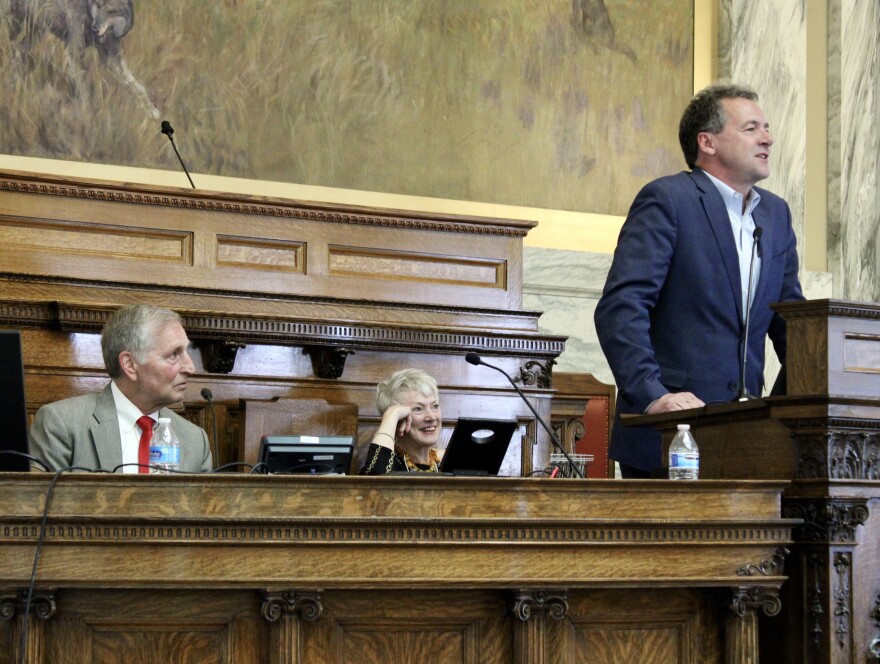
Mark Racicot Mae Nan Ellingson Steve Bullock
Racicot shared the podium during the final session of the 50th anniversary event with former Democratic governor Steve Bullock and with Mae Nan Ellingson, who, as the youngest delegate to the 1972 convention, had been one of the co-authors of the preamble. Racicot spoke of his concern that deepening political polarization and relentless struggles for power had become seriously detrimental to the state’s constitution and democracy. Speaking of the kind of leadership that might slow or reverse this downward spiral, Racicot said, “It requires universal self-discipline and uninterrupted prioritization of public over private or political interests. Subscribing to the rule of law requires each of us to limit our personal ambition.”
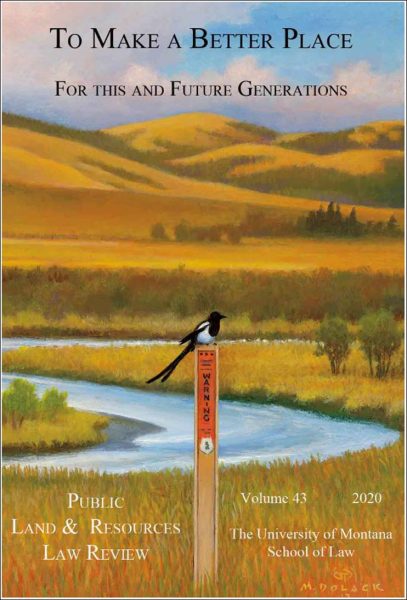
Meanwhile, Dorothy Bradley, the Democratic candidate in that 1992 race, had brought to the 50th anniversary event several copies of a remarkable volume she had edited, To Make a Better Place for This and Future Generations. There, Bradley had collected stories from the years surrounding the adoption of Montana’s constitution from many of the people who made that history. She reached both backward and forward, dedicating the volume to her father and placing the hard work on the constitution and its implementation in historical context:
“Looking back, I now see it was a rare moment when the stars really did line up – the right history, the right leadership, the right Montana mindset. … Usually, in the light of dawn, looking out at the beauty of the Crazy Mountains, I conclude that we thrashed our way pretty honorably. May the next round of warriors be so steadfast.”
Both Dorothy Bradley and Marc Racicot are living reminders to all Montanans that it is as a grateful people that we have constituted ourselves and dedicated ourselves to the hard work of self-government. Self-government has always been and will always be hard work, simply because, finding ourselves living together on these beloved landscapes, sharing them with others who turn out to have very different ideas about what it would take to live well here, gives us no choice but repeatedly to ask, “who exactly is this ‘we’ that is attempting to govern itself on these landscapes? That question never gets easy, but it is only by asking it honestly and sincerely that we can remain a self-governing people.
Daniel Kemmis, a former Speaker of the Montana House of Representatives, is the author of Citizens Uniting to Restore Our Democracy


Dear Mr. Speaker,
I have read your most recent edition below several times, and of course, while doing so, have not forgotten the insightful and moving introduction you shared at the State Capitol, from a place so familiar to you, during the Constitutional Convention 50 year celebration on June 15, 2022.
From Marc Racicot: Every time I read or recall your words, I find new insights and understandings that leave me comforted. You are, indeed, a very bright, intuitive, good and decent man. I’m grateful for your good heart, your long service to your fellow citizens, your keen intellect and your faith in the capacity of all of us to reveal the noble side of our humanity.
I wish you every blessing, Dan. All the best.
Marc